My heartfelt take on raising a child who loves airplanes
.png) |
| follow our journey at wander_with_sky |
So I am spending the weekend at a local restaurant with my son. A typical parent-child bonding activity except that I am constantly “ignored” when an airplane flew past us. His face lights up not at superheroes like most kids, but at the sound of loud airplanes. To him is sounded like “music”.
Yes, we are plane spotting. An activity only an aviation enthusiast can understand. You might probably wondered how I got into this situation, so let me tell you about it.
 |
| I am Sky and I planespot too, he got it from me |
I am a plane spotter myself. I even wrote about the art of planespotting a few years back. I discovered this fascination with aircraft when I was about 10 perhaps, gazing at the sky whenever I heard the sound of an airplane. I didn’t even know plane spotting is counted as a hobby. Even though I lived in the province before, far from any airport, I would still catch sight of aircraft passing overhead — just a tiny speck, barely visible. Yet my head was always on default mode, tilting upward in its direction. I would usually end up wondering, ‘Will I ever fly in one of them in my lifetime?’
Fast forward, I’ve flown many times on airplanes, and the fascination never ends. The more I’ve learned, the more I realize there are so many of them — different kinds of aircraft, their history, operators, liveries, and the places they’ve come from. All of this only fuels my never‑ending curiosity. Now that I am a mom of a ten-year old, this fascination is somehow passed onto him.
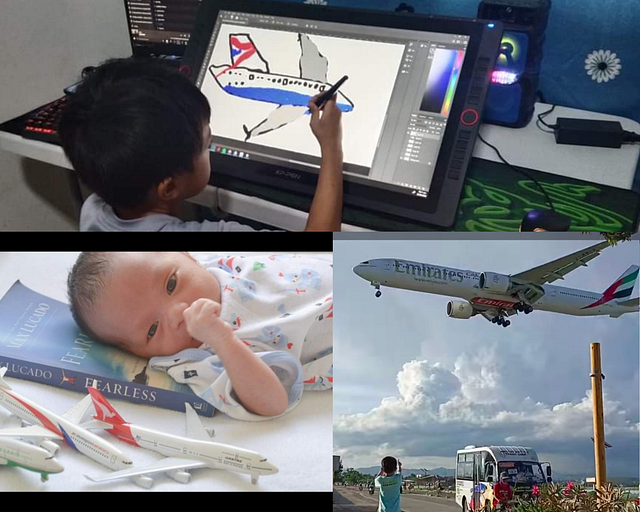
Maybe I am the one to blame. After all, I did a photoshoot with him when he was just weeks old, using my die‑cast collection, and I flew with him on his first birthday — his very first airplane experience — to a place we had never been before. So yes, I somehow kept a ‘traveling by airplane’ lifestyle alive when he was small.
Now, we spend our free time near the airport — camera in hand, flight tracker ready, and a heart full of patience. I influenced him, HARD. During my prime, I was lucky enough to spot the mighty and legendary An‑225 Mriya, and he went wild when he found out about it. From his perspective, the bigger and rare the airplane you spot, the more of a ‘GOAT’ you become — so technically, I’m a goat for him. So yes, here I am, accompanying him on his adventures, as he hopes to catch a rare one in his lifetime.
These are some of the things I’ve learned from having an avgeek son:
1. His endless questions about aviation will drive you crazy
Questions about aircraft types, history, and technology remind you that learning never stops — and it’s okay. I appreciate the constant questions and his aspirations of being on airplanes — which I know is an expensive one — makes him more interested in the world, technology and how he hopes to be part of it. But sometimes, it can really drive you crazy.
2. His attention to detail skill is quite impressive
Spotting liveries, operators, and rare aircraft sharpens his observation skills, and he keeps track of them diligently. For example, the ‘Let’s Fly Every Juan’ livery of Cebu Pacific is painted on only three aircraft, and he was thrilled to have flown on one of them, proudly saying, ‘Mamang, it’s 1/3.”. He knows the difference between an A320ceo and an A320neo. He knows aircraft models and variants. When flight tracking, he doesn’t just check the route — he also notes the registration numbers, liveries and the aircraft’s age. His photography skills are improving too. He knows how to properly position his camera to capture the plane from head to tail, making sure the registration number is visible, and even times his shots to catch the wheels opening and closing during take‑off or landing.
3. He yearns for travel adventures rather than material things
Most kids love to own certain material things that can somehow satisfy their passion for whatever they’re into (we maintain a die-cast collection though). My son hopes for more travel so he can spend time at the airport watching planes taxi or land. He values the boarding pass rather than toys and his marvels for engineering deepens gratitude for journeys. This craving is ultimately expensive, and I know I cannot always keep up, but I am working hard to afford it at least once a year. So far, Japan has been our priciest trip, and I hustled hard to afford it.
4. His lifelong dream starts with aviation
Of course, he wants to be a pilot when he grows up. During school career day activities, he dresses up like a pilot. God knows I am praying for abundance and strength to fulfill this dream for him. I am hoping it will motivate him to do well in school, as I’ve told him that being a pilot is a huge responsibility. Choosing a career path you truly love is deeply fulfilling, so maybe he’d start from here.
5. Our bonding is unique
Traveling requires us to dedicate a whole day solely to planespotting. Some weekends, we hang out at a restaurant near the runway and debate which plane is better at this or that. We wear matching accessories to show our love for aviation. When traveling, we take photos in cockpits and with pilots. We maintain a travel log, recording destinations, flight numbers, aircraft registration numbers, and the pilots who flew them. Since he loves to draw, we spend quiet weekends admiring his work and watching how he refines his artworks.
Reflecting on this journey with my avgeek son fills me with immense gratitude — for the lessons we’ve learned, the memories we’ve created, and the joy of seeing the world through his eyes. I pray for the strength and abundance to sustain this hobby and to support him in becoming whatever he aspires to be in the future.
How about you? How do you nurture your child’s passions, and what unique journeys have you taken together as parents? Please feel free to send in your comments.


